Work in progress
Sibling Spillover Effects of Chronic Illness on Educational and Labor Market Outcomes
This paper examines how the onset of a sibling’s chronic health condition affects the behavioral, academic, and long-run outcomes of children without chronic conditions. Using longitudinal data from the Panel Study of Income Dynamics–Child Development Supplement, I employ a within-child fixed-effects design that compares the same child before and after a sibling develops a chronic condition. I find little evidence of broad behavioral harm on average, but meaningful heterogeneity emerges. Siblings exhibit improved emotional regulation, including reductions in stubbornness and anxiety, alongside a modest increase in peer-relationship difficulties. These effects are concentrated primarily among girls in higher-income households, a pattern consistent with adaptive parentification supported by greater family resources. A planned extension will use sibling and genome-wide data from the National Longitudinal Study of Adolescent to Adult Health. By using a sibling’s polygenic risk for chronic illness as an instrument for illness onset, the analysis aims to strengthen causal identification, examine mechanisms such as parental time allocation and peer-network formation, and determine whether spillover effects persist into adulthood.
Standing Out and Bullying: Relative Height, BMI, and Adolescent Bullying Victimization
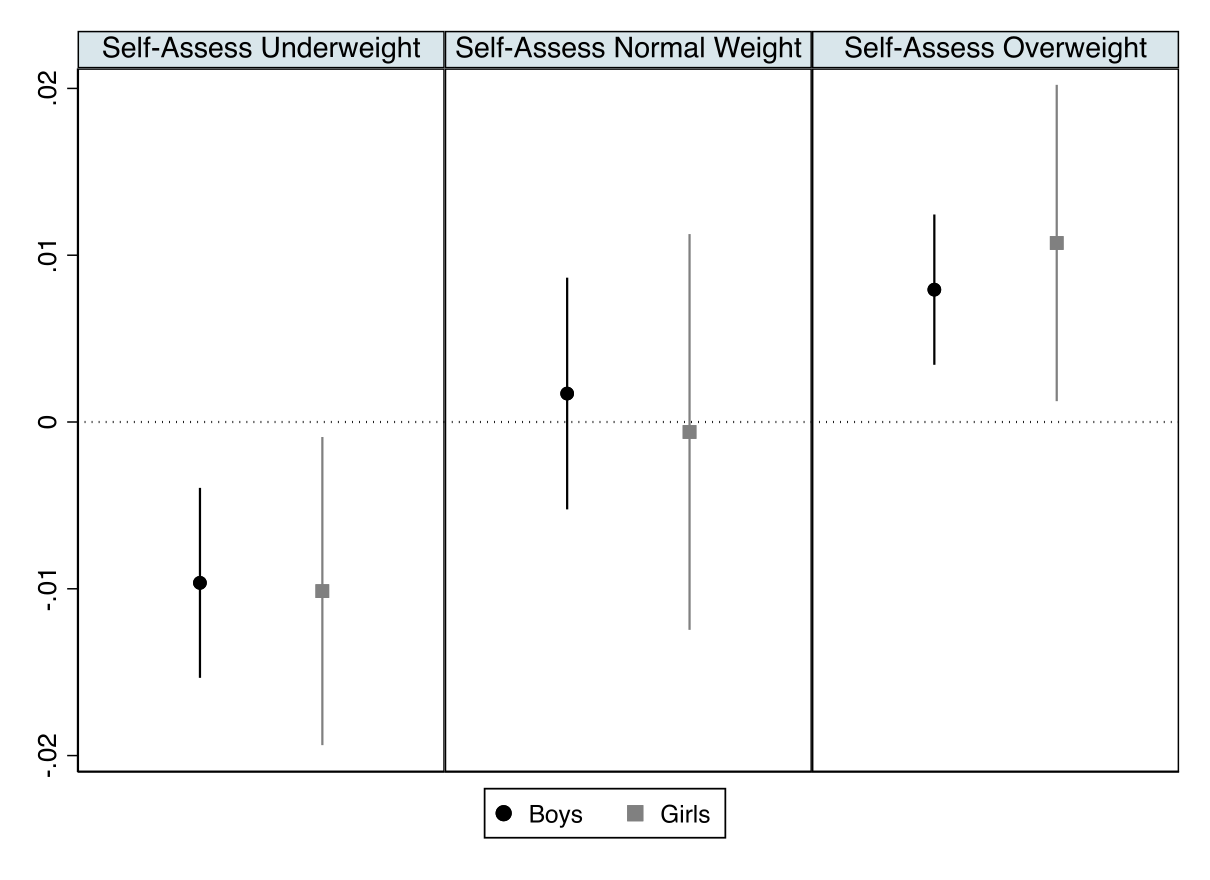
This paper examines whether adolescents’ physical characteristics relative to their peer group, rather than in absolute terms, predict bullying victimization at school. Using Youth Risk Behavior Surveillance System (YRBSS) district-level data from 2009 to 2021, I construct peer-relative measures of height and BMI within school district, grade, year, and sex cells, and estimate their association with self-reported bullying victimization using a linear probability model with district and grade-specific time trends. I find that being taller than one’s peer group is protective for boys but a risk factor for girls, while being heavier than peers is associated with higher bullying risk for both sexes, with a penalty nearly three times larger for girls. Heterogeneity analysis by weight category reveals that this weight penalty reverses among underweight students and compounds among already-overweight students, suggesting that the relevant mechanism is distance from the perceived peer norm rather than absolute body size.
The Effects of High School Students’ Class Choices on College Outcomes
This paper investigates whether the rigor of high school coursework, specifically, enrollment in Advanced Placement and honors courses relative to general academic tracks, affects the selectivity of the four-year colleges students attend. While prior research establishes a relationship between advanced coursework and the extensive margin of college enrollment, evidence on whether such coursework improves access to more selective institutions remains limited. Using the High School Longitudinal Study of 2009 (HSLS:09), a nationally representative cohort followed from ninth grade through postsecondary entry, the planned analysis will address the endogeneity of course selection using instrumental variables and regression discontinuity designs. The instrumental-variables approach will leverage variation in school-level access to advanced courses, while the regression-discontinuity design will exploit GPA-based eligibility thresholds for enrollment in these courses. By separating curricular rigor from underlying academic ability and family background, the study aims to estimate its effect on postsecondary selectivity and contribute to the literature on human capital signaling and college match.